
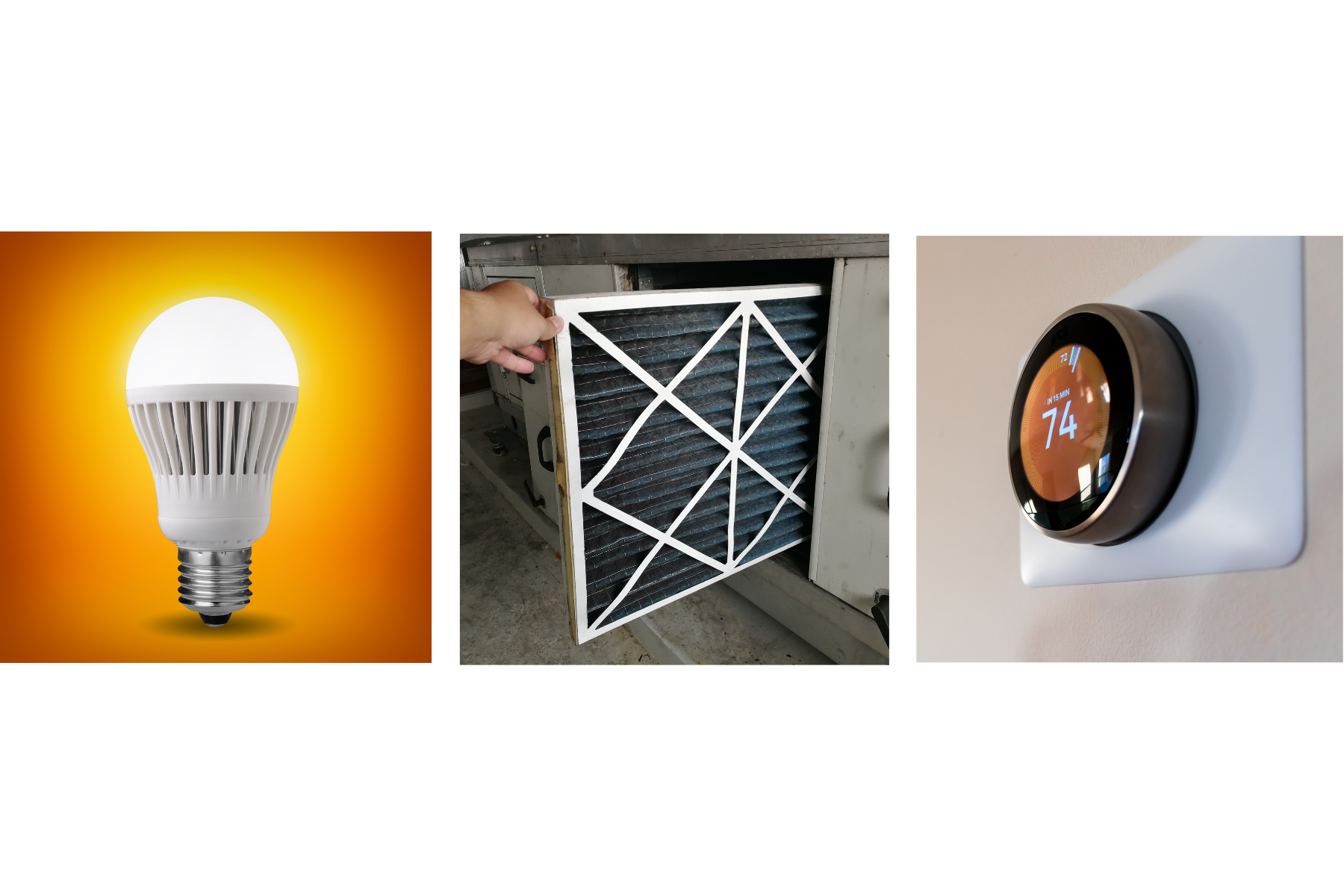
Here are ten tips that any good energy saver should not live without.
1. Replace any light bulb, especially ones that burn more than one hour per day, with a light emitting diode (LED) bulb.
2. Seal from the inside. Air sealing is an inexpensive way to lower energy costs and improve comfort. Seal gaps and holes in walls, floors, and ceilings with caulk or foam sealant. Look for cracks around windows and where wires and pipes pass through.
3. Plug electronic devices such as cable boxes, printers and TVs into power strips to turn off during vacations or long periods without use. Smart power strips make it an easy task to save money.
4. Close shades and drapes during the day to help keep your home cooler in the summer and warmer in the winter.
5. Change your central HVAC system filter when dirty by the manufacturers recommendations. Dirty filters can impact your home comfort and increase your electricity bill.
6. A one degree increase in heating setpoint or reduction in cooling setpoint can increase energy use by 3 – 5%.
7. Have your duct work checked for leaks. Leaks at the return, air handler and supply can be a major source of high bills. Mobile homes check at the grill, cross over duct and down flow air handler, for leaks.
8. Set both the upper and lower water heater thermostats no higher than 120 F. 9. An electric space heater can cost more than $100 per month to operate. Minimize their use, except for limited or temporary spot heating. Turn space heaters off when leaving the room.
10. Ensure refrigerator door seals are tight. Eliminate unnecessary refrigerators.
There’s one way to save on summer cooling costs – to reduce the amount of time that your air conditioner runs. For starters, make sure your system is running properly with good maintenance and service. Next, follow these tips to cool for less:
- Set the thermostat as high as comfortably possible during hot weather, we recommend 78 degrees. The less difference between the indoor and outdoor temperatures, the lower your cooling bill will be. Keep your house warmer when you aren’t home during the day, but cooler when you come home at night.
- Use a smart or programmable thermostat which saves you money by consistently turning up the thermostat when you’re away. You may set different temperatures for your home depending on whether you’re at work, at home or in bed at night.
- Clean your system’s filters and coils periodically. A dirty system deteriorates air conditioning performance and increases operating time. Filters should be changed every one to three months and the outdoor coil should be cleaned every year.
- Install LED lights, which emit pleasant light using less energy and without generating heat.
- Keep cooled air inside the home. Caulk and weather strip around doors and windows, close the fireplace damper and fill holes and gaps where wiring and pipes enter the house.
- Insulate your attic to the maximum practical depth of insulation.
- Use kitchen, bath and other ventilation fans only as long as needed. In just one hour, these fans can pull out a houseful of cooled air.
- Don’t use your oven on hot days.
- Line dry your clothes when possible.
- Install shades, blinds, awnings, sun screens or window films on your sunny-side windows.
- Circulate air with ceiling fans. Fans don’t actually cool a room – they just cool you – so be sure to switch the fan off when you’re not in the room.
- Keep the outside air conditioner unit free of air flow obstructions and trim back trees and shrubs at least two feet.
- Maintain your equipment to prevent problems. To keep your system at peak performance, maintenance should be done annually by a professional.
- Select energy-efficient equipment when you buy new heating and cooling equipment. Look for the ENERGY STAR label.
- Closing registers in unused rooms doesn’t usually help to reduce operating hours and may reduce your system’s efficiency.
Certain telltale signs indicate it’s time to replace cooling equipment or improve parts of your system to enhance performance. It may be time to call a professional contractor to help you make a change if:
- Your cooling equipment is 10 years old or more. New ENERGY STAR labeled equipment uses 25 to 40 percent less energy than typical 10-year-old models.
- Your equipment needs frequent repairs and your bills are increasing.
- Your system turns on and off frequently. This can indicate that your cooling system is not the right size leading to poor dehumidification and less comfort.
- Some of your rooms are too hot or too cold. Improper equipment operation or duct problems could be the cause.
- Your home has humidity problems.
- Your home has excessive dust. Leaky ducts can pull particles and air from attics and crawlspaces. Sealing your ducts could be a solution.
- Your cooling system is noisy.
Sources:
www.energystar.gov
Water heating is one of your home’s top energy expenses, accounting for about 14 percent of your utility bill. There are four main ways to cut your water heating bills:
Use Less Hot Water
A family of four, each showering for five minutes a day, uses 700 gallons of water a week. This is enough for a three-year supply of drinking water for one person. You can cut that amount in half by using low flow non-aerating showerheads and faucets alone. Follow these tips to reduce your hot water use:
- Install non-aerating, low-flow faucets and showerheads. New showerhead flow rates can’t exceed more than 2.5 gallons per minute (gpm) at a water pressure of 80 pounds per square inch. Purchase quality low-flow fixtures for around $10-20 a piece and achieve a water savings of 25 to 60 percent.
- Repair leaky faucets promptly; a leaky faucet wastes gallons of water in a short period.
- Purchase energy efficient dishwashers and clothes washers. Check the Energy Guide labels to determine how much energy these appliances use. Always purchase appliances with the ENERGY STAR label.
- Turn off your water heater when you’re on vacation.
- Install timer controls that will shut your hot water heater off during the night and during your cooperative’s peak demand times. This modest investment can pay for itself in lower bills in about 14 months.
Turn Down the Thermostat on Your Water Heater
- Lower the thermostat on your water heater. Many heaters are set to 140 degrees F or higher. For most households, 115-120 degrees F is sufficient. For each 10-degree reduction, you can save up to five percent on your water heating costs.
- After living with the new setting for a while, readjust it if necessary to a temperature that suits your needs. In addition to saving energy, you’ll increase the life of the water heater and reduce the risk of scalding.
- Drain a quart of water from your water tank every three months to remove sediment that impedes heat transfer and lowers the efficiency of your heater.
Insulate Your Water Heater
- Insulate your electric water heater tank and pipes, but be careful not to cover the thermostat.
- Choose an insulation jacket with an insulating value of at least R-8, or use two R-5 jackets if that’s all you can find. Jackets cost $10-20 and can pay for themselves via lower energy bills in less than one year.
- On gas water heaters, keep the jacket away from the drain at the bottom and away from the flue at the top, and make sure the airflow to the burner is not obstructed.
- Insulate hot water pipes, wherever they are accessible. This reduces heat losses at the tank and along pipes leading to faucets. You also won’t have to wait as long for the water to get hot when you turn on the faucet.
Buy a New, More Efficient Water Heater
- It may cost more initially, but the energy savings will continue during the lifetime of the appliance. It’s best to start shopping if yours is more than seven years old.
- New water heaters are insulated with up to one to three inches of high-efficiency foam.
Home energy use is different for everyone and hinges on several factors including size of home, members in your household, your location and preferences. Check out some easy ways to save energy and money to start making energy-saving changes in your home today!
- What are the best ways to save on a demand TOD rate?
- Alternate high usage appliances
- Precool and preheat your home
- Install a water heater timer
- Is insulation important?
- Insulation provides a barrier between unconditioned and conditioned spaces. The air transfer between these spaces is what causes most energy consumption.
- Insulation is important, but the most important action is air sealing.
- What are some signs that my heating and cooling system needs attention?
- Drastic changes in your utility bill
- System seems to run all the time
- Air inside your home seems sticky or humid
- Can equipment malfunction and run 100% of the time? How would I know?
- A hole in your well line, a clogged or stuck pressure switch, or a leaky water supply line will cause the well pump to run more often or stay one consistently.
- A heat pump’s heat strips can get stuck on. This will cause a drastic increase in your monthly bill even if it’s not heating season. If they get stuck during cooling season, your system will be trying to heat and cool at the same time, causing increased run times, and higher bills.
- Are annual HVAC inspections worth the money?
- The annual inspection is like the oil change and yearly inspection that your car gets. During this inspection, the technician should be looking at things like how well the system heats and cools, inspecting for leaks in refrigerant lines, dirty coils and drain lines, disconnected air supply lines, and temperature differences.
- “I can’t ever remember to change my air filter.” How important is it?
- Using a dirty air filter on the HVAC system is like running a race while breathing through a straw. Airflow is most important when it comes to good air exchange through your air handler.
- If you have a washable air filter, clean it monthly or every time you vacuum your home. If you hear a whistling sound coming from the return grill where the filter is located, it is definitely time to clean or replace the filter.
- What is air sealing? Do I have to remove my insulation to do it?
- Air sealing is the process of sealing any gaps around electrical, plumbing, or HVAC penetrations through walls.
- Insulation must be moved from around any pipes, electrical wiring, or duct work before sealant can be installed.
- How much does a space heater cost in electricity?
- A 1200-Watt space heater costs about 14 cents per hour to run. If it runs 10 hours per day, it will cost about $43 per month per space heater.
- A 1500-Watt space heater costs about 18 cents per hour to run. If it runs 10 hours per day, it will cost about $53 per month per space heater.
- Can my well pump get stuck on?
- Well pumps can get stuck on. This normally is caused by a cut in the water line, faulty pressure switch, leaky pipe or toilet, or faulty pressure tank.
- Should I call the utility if I get an EV charger?
- You should always contact the utility any time a large load is added to your home. EV chargers make up a substantial part of your home’s energy usage. Some units can add as much energy usage as two additional Air Conditioning systems when running at full capacity. These added loads can put extra strain on utility equipment such as transformers and wiring causing over loading and dimming lights.
SmartHub Can Help You Take Control of Your Energy Use
SmartHub’s innovative tools help you understand exactly where your energy dollars go, how to save money and how to avoid billing surprises. Best of all, these features are available for free to all members. Check out SmartHub’s home profile to help you figure out where to start. Knowing how you use energy will help prioritize your energy-saving habits.